
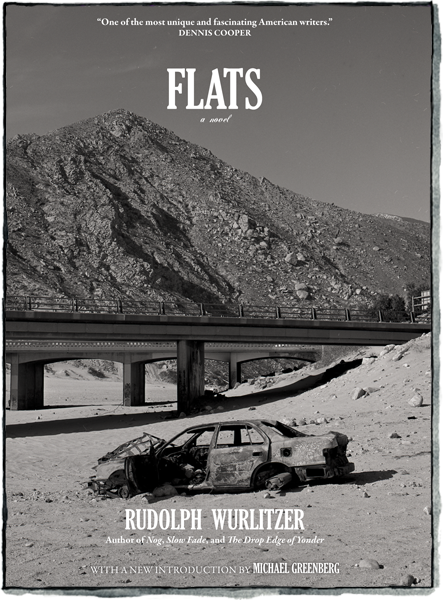
1st Printing Features: Trade paper, 69ed edition
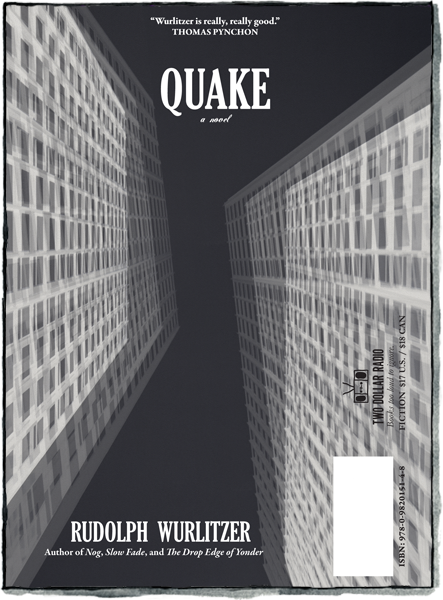
Flats / Quake
a novel (2 in 1!) by
Rudolph Wurlitzer
ABOUT
This paperback book is being reprinted and currently unavailable here. Indie bookstores may have copies though, so please inquire with your fave indie!
"Push aside Brautigan and Ginsberg and make room in the curriculum for Wurlitzer as an overlooked and undervalued voice of the counterculture of the '60s and '70s, wedged comfortably between the collected works of Willam S. Burroughs and Hunter S. Thompson."
—Rodger Jacobs, PopMatters
Synopsis
Flats is a post-apocalyptic exploration of the human self. Submerged amidst a cast of faceless characters named after ruined American cities who compete over a shrinking fringe of space, Flats is a modern masterpiece of the counterculture.
Quake chronicles the unraveling of society after an earthquake strikes ’60s Los Angeles. By painting a bleak picture of what people are capable of doing to one another in extreme circumstances, Quake is nihilistic and haunting, as well as uncomfortably foreboding. And more relevant than ever.
Flats/Quake by Rudolph Wurlitzer =
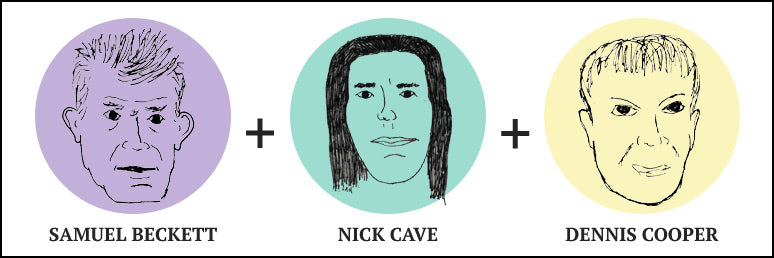
* In most cases, none of these writers endorse this book. Our math formulas are supposed to be amusing anecdotes, similar to shelf-talkers in bookstores that say "If you like X, you might enjoy Y," or "This Book is like Cormac McCarthy writing an episode of Saved by the Bell with a soundtrack by Philip Glass."
Reviews
"Each book is short, but dense and trippy. If you want to know what it felt like to be a reader in the late '60s and early '70s, when so many new experimental works were put out by mainstream publishers, these books are great places to start. Nog even had a blurb from Thomas Pynchon ("the novel of bullshit is dead!"), Flats wore its Samuel Beckett influence proudly on its sleeve, Quake took us through a slo mo pomo earthquake in L.A. Together they provide a tour of the dissolution of identity that was daily life in the late sixties."
—Michael Silverblatt, KCRW's Bookworm
"Reading Rudolph Wurlitzer's novels is like watching a road movie backward. In his 1969 underground classic, Nog, the narrator drifts across an amorphous terrain on which his shifting identity molds itself like soft clay. Flats and Quake mine much the same territory, a post-cataclysmic landscape in which heroic storytelling has been blown to bits. Quake reads like a mash-up of On the Road and Waiting for Godot. For the first time in more than three decades, it's possible to investigate the interplay between Wurlitzer's novels and his screenplays, the way his radical experiments in one informed his canny deconstruction of the other."
—Los Angeles Times
"Push aside Brautigan and Ginsberg and make room in the curriculum for Wurlitzer as an overlooked and undervalued voice of the counterculture of the '60s and '70s, wedged comfortably between the collected works of Willam S. Burroughs and Hunter S. Thompson."
—Rodger Jacobs, PopMatters
"THE BIG NOWHERE: RUDY WURLITZER’S REDISCOVERED TRILOGY AND BOB DYLAN REVISITED"
"The reader, the writer, and the denizens of [Flats] all get taken for a ride here, then are set down, slightly more cracked than they were before. [Quake] is Wurlitzer at his most Pynchonian. The frontier—alluded to in Flats, deconstructed in Wurlitzer's 1973 screenplay for Pat Garrett and Billy the Kid, and played for laughs in last year's Drop Edge of Yonder—is again the subject [in Quake], posited this time as the place where humans turn back into whatever they turn back into when the marijuana and Social Security run out."
—Village Voice
Authors

Rudolph Wurlitzer is the author of the novels Nog, The Drop Edge of Yonder, and Slow Fade, and a non-fiction book, Hard Travel to Sacred Places. He has written numerous screenplays, including Pat Garrett and Billy the Kid, Two Lane Blacktop, and Walker.
Michael Greenberg (Introduction) is the author of the best-selling memoir Hurry Down Sunshine (Other Press, 2008), which depicts his daughter's battle with bipolar disorder, and Beg, Borrow, Steal (Other Press, 2009), a New York writer's memoir.
info
LIST PRICE: $17.00
PAGES: 270
PRINT ISBN, "69'ed" edition: 9780982015148
INTRODUCTION: Michael Greenberg
RELEASE DATE: 10/1/2009
EBOOKS:
Flats: 9781953387639
Quake: 9781953387646








Be the first to know! Click to visit the Newsletters page to sign up for the Two Dollar Radio newsletters.
Hi there!

Latest posts
-
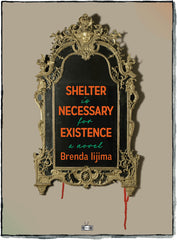
Q+A with Brenda Iijima about Shelter Is Necessary for Existence
In October 2026, we are proud to be publishing Brenda Iijima's second novel, Shelter Is Necessary for Existence, a work of social satire wrapped in the patina of a psychological thriller. Narrated by the matriarch of an affluent family in... Read more →
-
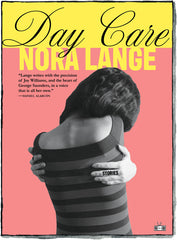
Q+A with Nora Lange about Day Care
In September 2024, we released Us Fools, the debut novel by Nora Lange, which went on to be a Los Angeles Times bestseller, a best book of the year at The Boston Globe and NPR, and win the Sue Kaufman Prize... Read more →
-
Zachary Pace in Columbus, Ohio
Introduction by Brett Gregory: Zachary Pace is the author of I Sing to Use the Waiting: A Collection of Essays about the Women Singers Who've Made Me Who I Am. This book is special. It's accessible and informative, yes, but it's... Read more →